
The Birth of Ymir
Before gods or men, before the world took shape, ice met fire and the first life awoke.
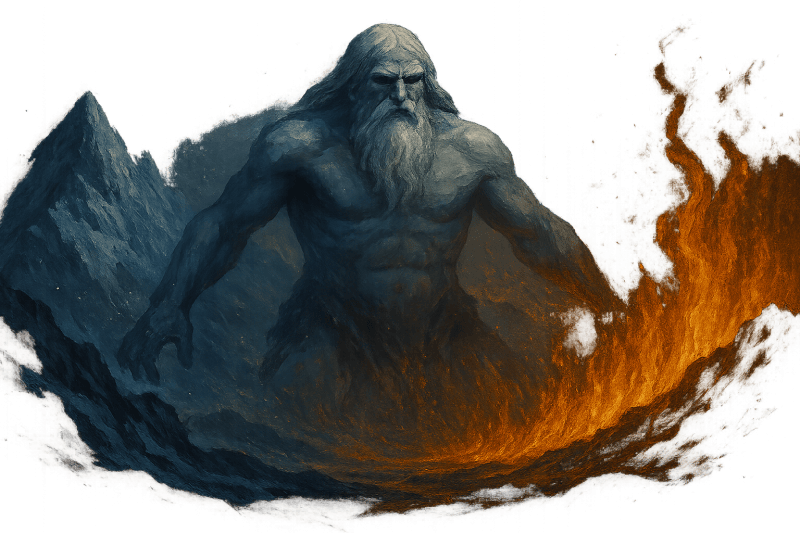
In the beginning, there was nothing—no sky, no sand, no life, no grass. Only a vast, silent, and dark void.
The Vikings named it Ginnungagap.
The Void Before All Things
Before the world existed, there was only nothing — no light, no sound, no shape.
Just the vast emptiness of Ginnungagap, the great void that extended beyond all thought and measure.
Within this boundless chasm, time itself had not yet started to flow.
To the north, the void met Niflheim, a realm of shadow and biting frost, where rivers of venom and mist twisted through the darkness.
To the south lay Muspelheim, a realm of living flames, guarded by the fire giant Surtr, whose sword blazed brighter than the sun that would one day be.
For ages uncounted, frost and flame drifted toward each other — patient, silent, eternal.
And when their touch finally met in the heart of the void, the first breath of creation stirred.
The Birth of Ymir
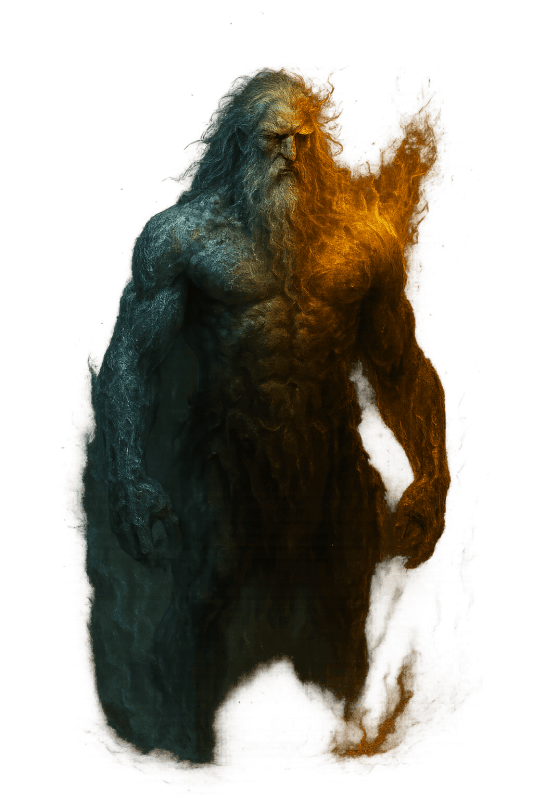
When the heat of Muspelheim met the cold of Niflheim, the frost began to melt.
From those rivers of melting ice, came drops that gathered and grew, until they shaped the form of a living being — immense and ancient.
Thus was born Ymir, the first of all creatures, the father of giants, the embodiment of chaos given flesh.
Ymir stirred in the dark, and his breath became mist, his movements like rolling waves.
From the sweat of his body emerged new life — the Jötnar, frost giants who would inherit his strength and his hunger.
Yet Ymir himself was alone, knowing no kin nor master, bound only to the endless silence of Ginnungagap.
From the melting frost emerged Audhumla, the primal cow, nourisher of worlds.
Her milk sustained Ymir, and from her udder flowed four rivers of nourishment.
As she licked the salty stones of the void, she uncovered the shining form of Búri beneath her tongue, the first of the gods. First hairs appeared, then a head, arms, legs, and finally the complete body of the god.
Búri fathered Borr, who took to wife Bestla, a daughter of the giants. From their union were born three sons — Odin, Vili, and Vé, who would soon shape the world from Ymir’s remains.
From the melting frost, the giant awoke — vast, ancient, and alone.
The Gods Rise
The sons of Borr — Odin, Vili, and Vé — looked upon the endless void and felt the stirring of purpose. They journeyed through Niflheim, shrouded in mist, and Muspelheim, ablaze with eternal flames.
In their hearts burned the will to shape, to order, and to give meaning to the chaos left behind. They understood that a sacrifice was necessary for their plan to succeed. The choice fell upon Ymir. And there he stood. Vast and formless – the shadow of all that was unmade.
They understood that creation could not grow while Ymir still lived, for his body filled all space, and his breath carried the chill of death.
Together they rose in defiance — the first act of divine rebellion — and struck down the ancient giant with sword and hammer. When Ymir fell and the ground trembled, Odin shouted triumphantly.
From his open veins flowed the rivers that would one day become the seas of the world.
When the battle ended, silence returned to Ginnungagap, but it was no longer empty.
The brothers stood amid Ymir’s fallen body and saw in his ruin the spark of creation
From his flesh, they shaped the land; from his blood, they filled the seas; from his bones, they raised the mountains; and from his skull, they arched the heavens.
- From his flesh, the land.
- From his blood, the seas.
- From his bones, the mountains.
- From his teeth, the stones.
- From his hair, the trees.
- From his skull, the heavens.
- From his brows, Midgard — the realm of men.
The Remnants of Chaos
Yet even as the gods shaped the world from Ymir’s vast remains, not all of his kin perished.
From the crimson flood that poured from his wounds rose Bergelmir, the grandson of Ymir, who escaped the deluge with his wife aboard a hollowed tree trunk.
They fled into the distant wilds, and from them arose the new race of Jötnar, the giants who would forever dwell beyond the gods’ walls — their hearts filled with the memory of vengeance.
The gods named their realm Jötunheim, the Land of Giants, and banished it to the farthest edge of the new world, beyond mountains and vast seas.
There, frost and storms would prevail, so that chaos might live, but never rule again.
The Dwarves and the Sky’s Pillars
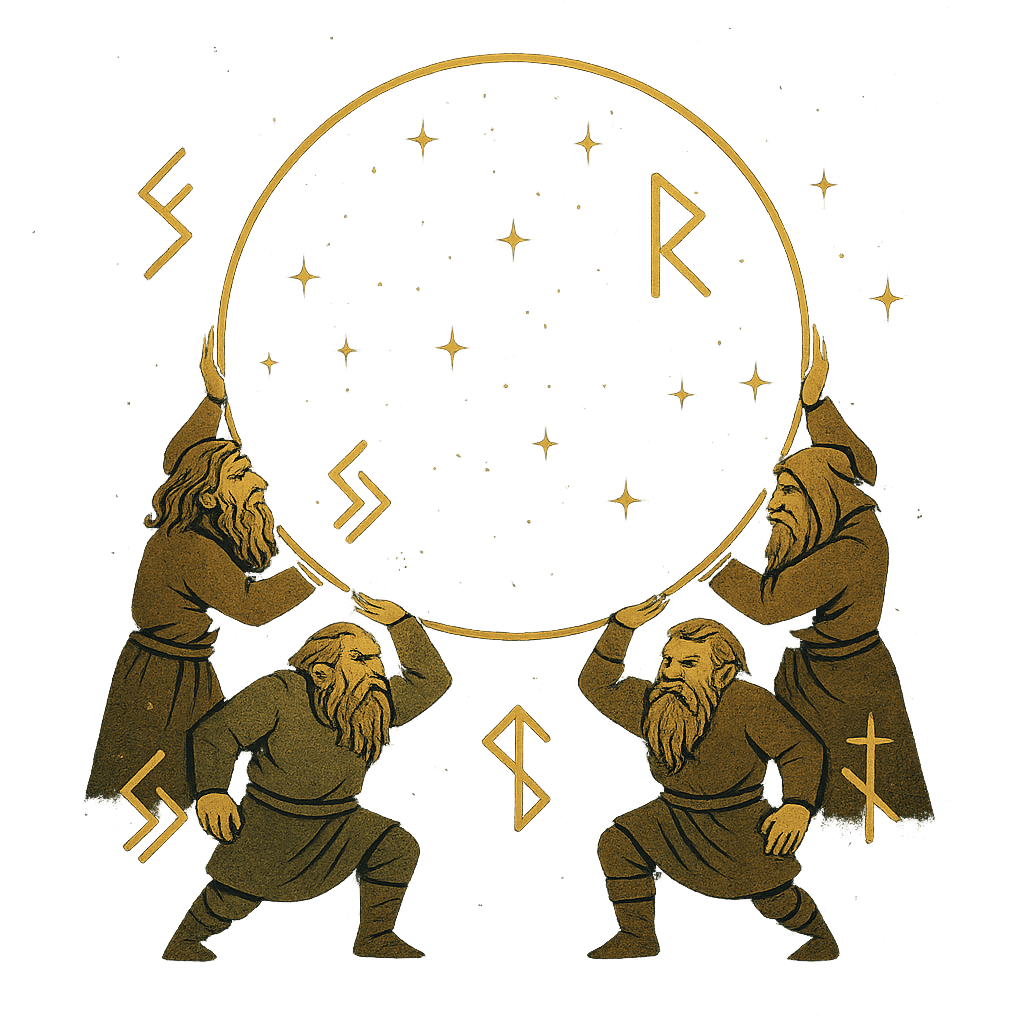
When the gods lifted Ymir’s skull, shattered by Odin, to create the heavens, they feared it might collapse.
To hold it firm, they summoned four spirits born from the bones of the earth — the first of the Dwarves, beings of stone and craft.
They were placed at the four corners of the world and named Austri (East), Vestri (West), Nordri (North), and Sudri (South).
There they remain, silent and steadfast, pillars of the sky, eternal guardians of balance.Beneath the mountains, other dwarves descended into the deep stone halls, crafting jewels and blades, forging hidden secrets in the darkness.
Their hearts were bound to the earth, their fate to shadow and flame.
Then Odin scattered Ymir’s brain across the newly formed sky, creating rain clouds. He collected sparks from the ever-burning fires of Muspelheim and sprinkled them throughout the sky like stars.
And so the heavens were set upon Ymir’s skull, the pillars stood firm, and the stars found their course across the void.
The seas calmed, the mountains held, and silence embraced the newborn world.
Yet the gods understood their work was not complete — for though the sky was firm and the earth strong, the world itself had no heart.
Between fire and frost, in the still center of all things, a new realm waited to be shaped.
From ice and fire, from blood and breath — the world was born, and so it shall end.
Read Next
Continue the story — The Sun and The Moon.