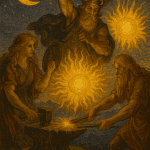
The Eye of Ra: Divine Wrath and Restoration
When order slept and men forgot the light,
the sun opened its eye — and the world remembered fear.
Before the rivers had names and before sand knew shadow, Ra rose alone from the waters of creation.
He spoke, and the world was filled with light.
He ruled from the horizon to the western gate of night, where the sun descended to rest upon its golden barque.
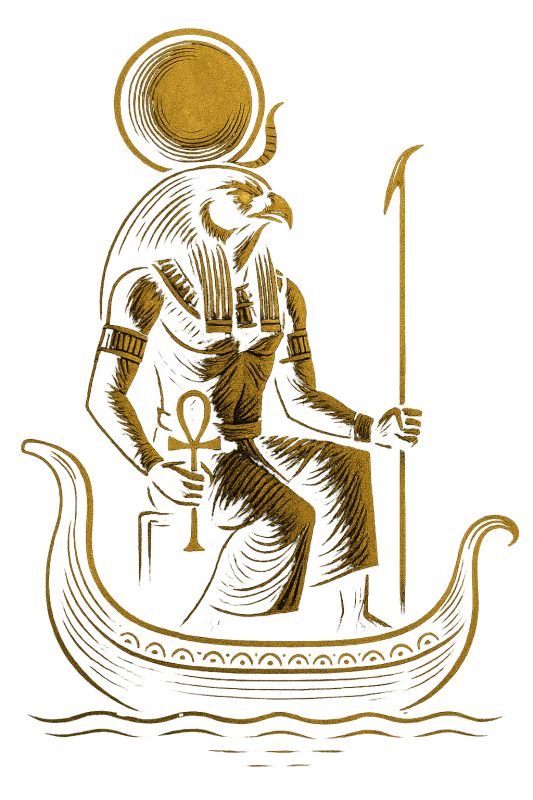
Each morning, Ra rose in his solar barque, the Mandjet, cutting through the endless ocean of the sky.
At his side stood Sia, the god of perception, and Hu, the divine word that commands creation.
Before the prow, the scarab Khepri rolled the orb of the sun from the shadowed depths of night, pushing it toward the living lands.
When the people bowed at dawn, they believed they were helping Ra rise again, that the sun itself leaned upon their faith.
So long as they sang the hymns and burned the incense of morning, the world was in harmony, and Ra’s journey across the heavens remained unbroken.
To the people of Kemet, Ra was more than a god — he was the living pulse of the world.
Each dawn marked his rebirth; every sunset, his death and vow to return.
His was the warmth that fed the earth, the light that banished chaos.
And so long as the sun shone, Ma’at — the balance of the world — would endure.
But even the eternal light can grow weary, and the hearts of men, ungrateful.
The Waning of Reverence
As centuries turned like the sun’s wheel, mortals forgot the covenant. Their temples decayed, their faded into silence.
They erected monuments in their own honor rather than to the gods. And from his throne upon the edge of heaven, Ra looked down and saw that the world had grown proud.
Where once smoke of incense rose from cities, now only dust and laughter drifted skyward. But harmony is fragile, and gratitude fades swifter than light. In the city of Heliopolis, where priests once chanted the Hymns of Dawn for every day of the year, silence began to settle in the sacred halls.
Altars cracked, and dust layered the once-gleaming obelisks. The people spoke Ra’s name less often, trading faith for pride and the comfort of their own creations. Statues of the Sun Lord stood abandoned, their eyes dim, their crowns dulled by sand. Only the elders remembered the warmth that once came not from flame, but from reverence. And in the heavens, Ra gazed upon this fading devotion and felt a shadow cross his light.
The mortals whispered:
” The sun grows old. The gods no longer see us. “
But Ra saw.
And within his golden heart stirred a flame that would soon devour all that had forgotten fear.
The Birth of the Eye
In the oldest hymns, the Eye of Ra is described not as a weapon or a goddess, but as a living spark of Ra’s very essence — his vision made manifest, his power unleashed without mercy.
It was said that when the Eye opened fully, even light itself would tremble. Through it, Ra perceived the wickedness of men and the quivering of spirits. The Eye could burn or bless, nourish or destroy — for it embodied both justice and judgment, the giver and the devourer.
To mortals, the Eye was the sun’s radiance. To gods, it was the very will of creation itself. The gods trembled when Ra withdrew into solitude, for they had never seen the sun itself turn inward.
From his own being he tore forth a single ember of light — too fierce for mortal sight — and shaped it into thought and will.
That ember became the Eye of Ra, a being neither born nor created, but separated.
This act disrupted the divine order. Even Ma’at shuddered, for never had power been divided from its source.
The heavens dimmed briefly as the Eye opened, perceiving all things—and for the first time, even gods feared the day.
Through the Eye, Ra’s will reached into the mortal realm, embodying the eternal balance of light and judgment that upheld Ma’at. And when Ra could no longer bear the folly of mankind, he summoned the Ennead — the divine council — to decide their fate.
The Council of the Gods
The gods gathered in the Fields of the Horizon, a place of golden light and endless air.
Thoth, the lord of wisdom, urged patience. Shu whispered of balance. Hathor pleaded for mercy. But others, born of the fire of Ra, murmured that the age of mortals had grown insolent.
So Ra, in his fury, tore a fragment of flame from his brow — a piece of his soul, bright and fierce — and hurled it into the world below.
From the spark arose Sekhmet, the lioness of flame, the living Eye incarnate.
The Unleashing of Sekhmet
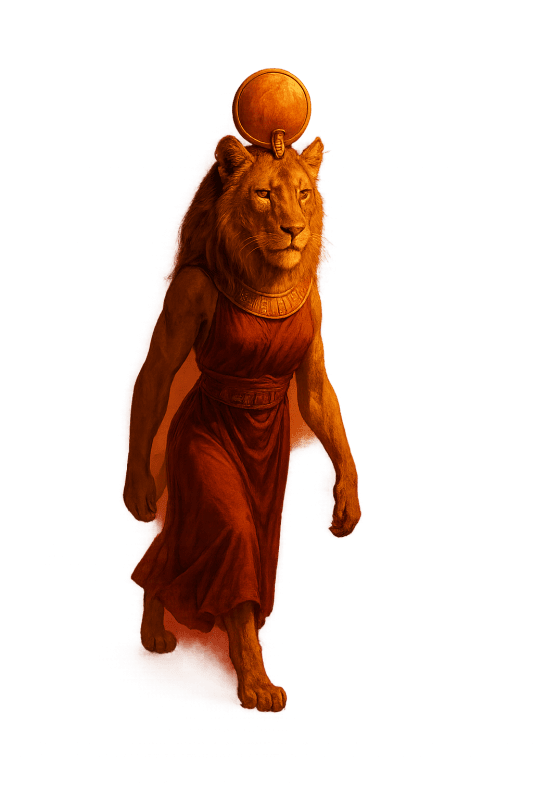
She walked across the sands, and her steps turned them to glass.
Her breath was the heat of noonday, her mane blazed like a crown of fire. Where her gaze fell, men perished.
Sekhmet, the “Powerful One,” became the wrath of Ra.
Villages were consumed by flames, the Nile flowed crimson with the blood of the proud, and even the gods averted their gaze from her hunger .
The sands of Memphis fused into glass beneath her paws, the palm trees burned though no wind carried spark or ash.
Men tried to hide in the temples, but the gods had turned their faces away, unwilling to stand before her.
She hunted not out of hatred, but by divine instinct — to purify, to punish, to restore balance.
Those who saw her eyes said they burned like twin suns, reflecting the world’s sin in mirrored fire.
The Nile itself appeared to shrink away, its waters darkening, thick with blood.
And when the moon rose, it was said to be pale not from its own light, but from the terror it reflected below.
Sekhmet was the truth of Ra’s wrath — beautiful, divine, and unstoppable. Her laughter was the sound of battle, her shadow the promise of judgment.
Even the other gods whispered: “The sun devours its children.”
The mortals who mocked the sun now cried for its mercy — but Ra, burdened by the wrath of his own creation, wept tears that transformed into rubies as they fell upon the earth.
The Red Wine of Peace
Seeing the slaughter, Ra repented.
He summoned Thoth, the scribe of wisdom, and asked how to end the Eye’s rampage without breaking the sacred balance of Ma’at.
Thoth answered:
” The lioness must not be slain, for she is your power made flesh.
But her thirst may be sated with illusion. “
The gods poured seven thousand jars of beer, tinted deep crimson with pomegranate and ochre, scattering them across the desert where Sekhmet roamed in pursuit.
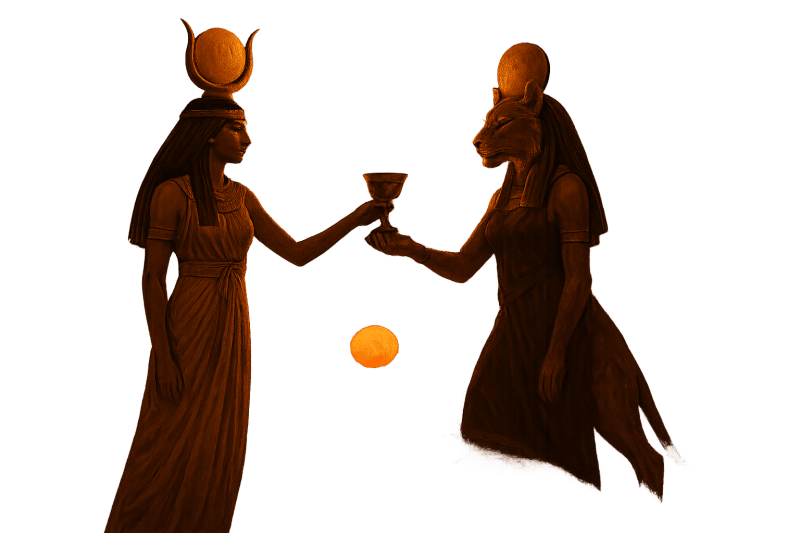
When the lioness saw the fields stained red, she drank deeply, believing it to be blood. Her rage melted into laughter, her breath cooled, and when she awoke, her eyes no longer blazed with hatred, but shone with gentle light.
As dawn broke, the desert was silent. From the dunes rose a woman, no longer lioness but radiant with love. The sun rose behind her, and the sand turned gold once more. Sekhmet’s fury transformed into joy — and she was now known as Hathor, the Restorer.
The Wandering Eye
In the ages that followed, the Eye grew restless once more. Though she had found peace, her essence remained bound to the horizon — to change and renewal. It is said she fled from Ra’s presence and journeyed to the distant lands of Nubia, where the sun bled into the red earth.
The world darkened, crops withered, and Ra aged in sorrow. He sent Thoth, wise and cunning, to seek her out.
Thoth disguised himself as a baboon and told the Eye stories that made her laugh again. Through tales and music, he reminded her of her purpose — not to destroy, but to shine.
When she finally came back, she brought with her laughter, beauty, and renewal. Her return became the sunrise, her departure the dusk.
The Eye’s journey reflected the eternal cycle of the heavens — anger, retreat, and rebirth.
The Many Faces of the Eye
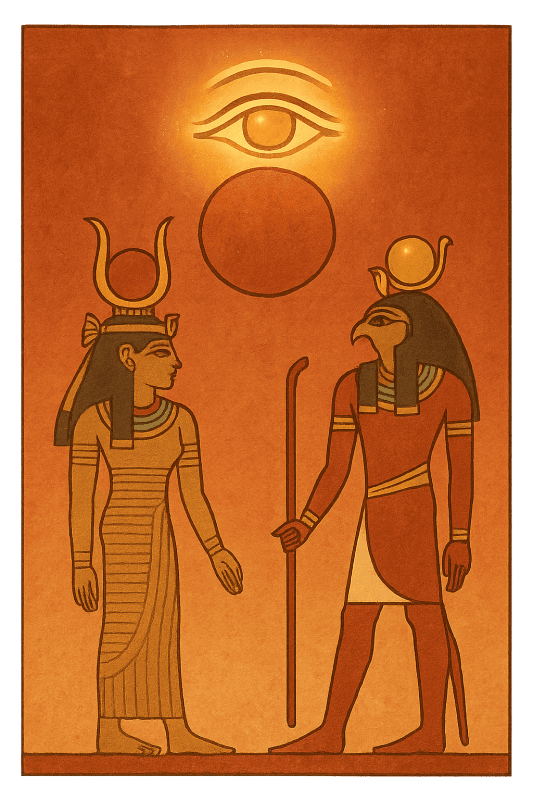
Through centuries, the Eye took many forms and names. We shall mention some of them:
- As Sekhmet, she was destruction and protection.
- As Hathor, she became joy and fertility.
- As Wadjet, she coiled as the sacred cobra upon the pharaoh’s crown.
- As Mut, she guarded kings.
- As Bastet, she softened into grace and domestic warmth.
Though united in spirit, the Eye wore many masks.
In battle, soldiers prayed to Sekhmet; in childbirth, women whispered to Hathor. Farmers called upon Bastet, the soft-footed guardian of home and hearth. Kings bore Wadjet upon their brows — the serpent whose gaze turned enemies to dust. Even priests debated her truest face, for the Eye was all of them and none. To those who lived in her light, she was protection; to those who defied it, annihilation.
Each face was a season of the same sun — dawn’s mercy, noon’s power, dusk’s forgiveness.
The Eye and Ma’at
The Eye was the living law of Ma’at, the universal order. It punished the arrogant and shielded the faithful.
Kings ruled under its light, and priests called upon its name at dawn to ensure the sun would rise once more.
In temples and tombs, it watched — etched in stone, painted on the walls of eternity — a solemn vow that no falsehood could evade divine vision.
Even the pharaoh bore it upon his brow, the uraeus serpent, ever ready to strike at chaos.
It was said that the Eye could not sleep, for if it closed, the world would fall into shadow forever.
Rituals and Amulets
Across Egypt, amulets shaped like the Eye were worn as powerful talismans of protection. Crafted in gleaming gold, deep lapis, and fiery carnelian— the hues of dawn — they shimmered with ancient magic.
In every age, the Eye was honored not just in temples but in the smallest acts of life. When a newborn cried, a mother drew the Eye in oil upon the child’s forehead, so no shadow could claim it.
When soldiers marched, they wore amulets of gold and carnelian, believing her gaze would blind the arrows of their foes.
Even the dead carried her symbol carved in lapis, to light their way through the Duat and protect them from the serpent Apep.
The pharaoh, chosen of Ra, bore the Eye as a living crown — a coiled serpent upon his brow, the uraeus, ever watchful.
It hissed in the name of divine justice and struck at those who dared raise hand or thought against the balance of Ma’at.
Priests sang:
“O Eye that sees all things,
burn the darkness from our hearts,
and light our path until the sun returns.”
At morning prayer, priests lifted their hands toward the sun, softly whispering the names of the Eye’s manifestations:
“Sekhmet to guard, Hathor to heal, Wadjet to watch.”
The Eye was no longer merely Ra’s weapon — it had become the covenant of light, renewed with every sunrise.
The Legacy of the Eye
When Egypt’s temples crumbled to sand, the Eye’s light did not fade — it changed. In the lands of Greece, she became the halo of Helios.
in Rome, the eternal flame of Sol Invictus. Centuries later, her symbol appeared again — the all-seeing eye of wisdom, carved upon altars, etched into crowns, even hidden in sacred art.
To scholars, she is myth.
To mystics, she is the eternal witness.
To the faithful, she is the proof that no deed escapes the light.
In every dawn that breaks across the world, the Eye opens once more — not in wrath, but in remembrance.
And to those who look upon it with humility, the light is not blinding, but forgiving.
Even today, its symbol lives on in art and faith, not as a token of fear, but as a powerful reminder:
Power without compassion becomes fire without warmth.
The Eye of Ra is not lost — it rests within the gaze of every rising sun, watching, waiting, and remembering.
The Balance Restored
So ended the wrath of Ra, and so began the age of mercy.
Sekhmet’s name was not forgotten, nor her fury erased.
For the gods knew — and the mortals learned — that creation itself requires both flame and peace.
When the sun bleeds red at dusk, the wise still whisper:
” The Eye watches, but it no longer weeps. “
Read Next
Next in the Egyptian Cycle: 🜏 The Descent to Duat — The Journey Beyond Light